12 Signs You Have Termites (and What to Do Next)
The 12 signs of termites Adelaide homeowners miss most: mud tubes, hollow timber, stuck doors, discarded wings, and what to do the moment you spot one.
Key takeaways
- Termites rarely announce themselves with visible insects. Most Adelaide homeowners find the damage, not the pest, months after the colony arrived.
- Mud tubes, hollow-sounding timber, and doors that suddenly stick are the 3 most reliable early signs, and none of them require you to see a live termite.
- Limestone-based soil across much of Adelaide's plains lets subterranean termites travel through cracks that would stop them on clay or heavy loam elsewhere.
- A cluster of small signs together (not one alone) is what should trigger an inspection, since single symptoms often have a boring, non-termite explanation.
- Disturbing a suspected nest or spraying a supermarket aerosol on mud tubes can scatter the colony and make the eventual treatment harder, not easier.
The clearest sign you have termites is rarely a live insect. It is physical evidence left behind: mud tubes on a foundation wall, timber that sounds hollow when tapped, doors that suddenly stick, or discarded wings near a windowsill after a warm evening. Termites work inside timber and out of sight, so by the time you notice something, the colony has usually been active for months.
Homeowners expect a pest problem to look like a pest problem: something crawling, something visible. Termites do not cooperate. Most of the damage happens behind skirting boards, under flooring, and inside stumps, and the first thing homeowners actually notice is a symptom of the damage, not the termites themselves. Here are the 12 signs worth knowing, and what separates a genuine red flag from something more mundane.
1. Mud tubes on foundations, piers, or walls
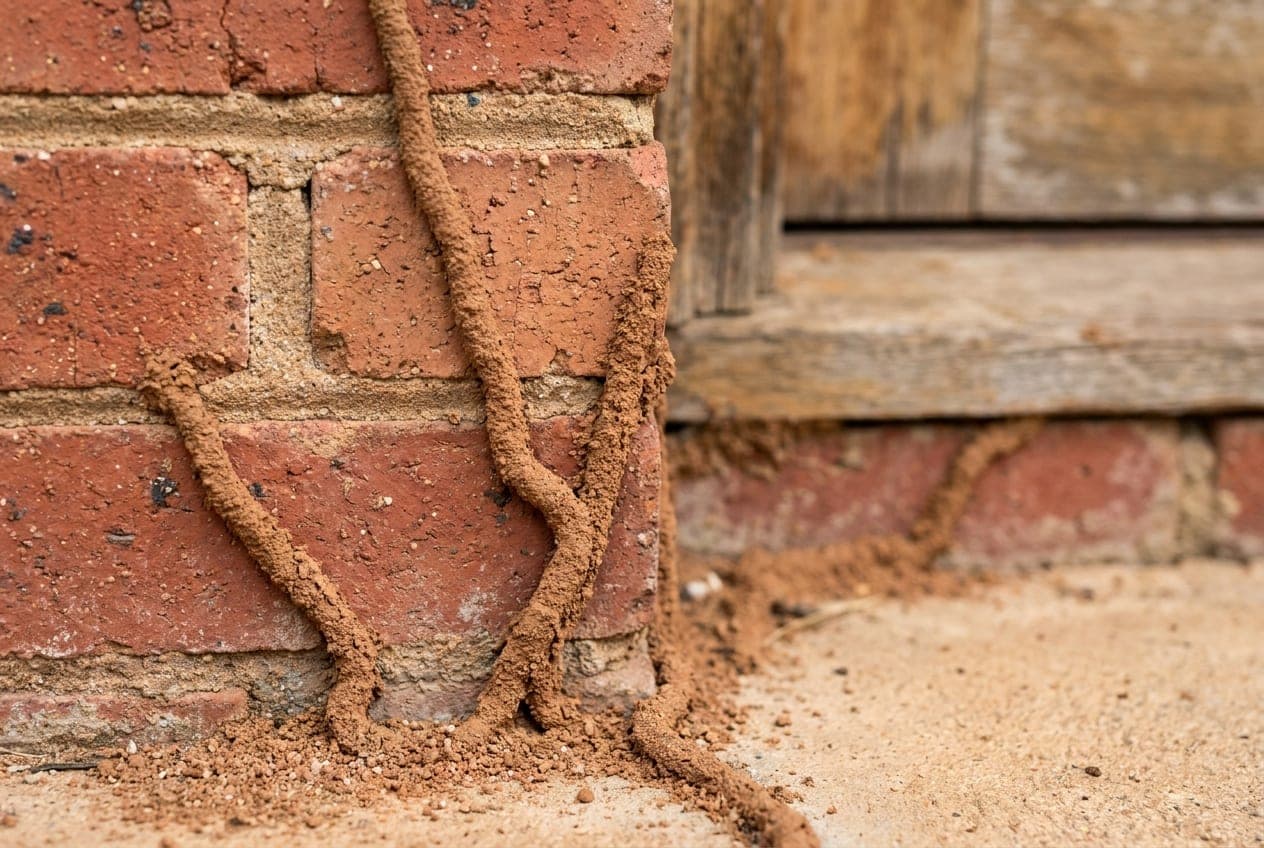
Subterranean termites build pencil-width mud tubes to travel between soil and timber while staying protected from light and dry air. You will usually find these on brick foundations, timber stumps, besser block, or up the outside of a slab edge where render meets soil. A tube that is intact and slightly moist suggests active feeding. One that is dry and crumbly may mean the colony has moved on, though the timber it fed on should still be checked. For a closer look at what these look like across different Adelaide construction types, see what termite mud tubes look like and why they matter.
2. Hollow or papery-sounding timber
Tap skirting boards, architraves, or exposed structural timber with the back of a screwdriver handle. Healthy timber gives a solid, dull knock. Timber hollowed out from the inside sounds papery in a way that feels distinctly different once you have heard the contrast. This is one of the most reliable signs because it does not rely on seeing anything, and it usually means damage has already progressed a fair way through the timber.
3. Doors and windows that suddenly stick
Timber warps as termites hollow it out and moisture changes inside the damaged sections. If a door or window that opened and closed easily for years suddenly binds or drags, with no obvious cause like humidity or a dropped hinge, termite damage to the frame is worth ruling out. Ground-level doors on older stumped homes, common through the western and southern suburbs, sit closer to subfloor activity than upstairs doors in the same house, so a ground-floor door sticking on its own is a more specific tell.
4. Discarded wings near windows or light fittings
After a swarm, alates (the winged reproductive termites) shed their wings almost immediately once they land. A small pile of uniform, translucent wings on a windowsill or near an outdoor light is a strong sign a colony nearby has recently swarmed, even if you never saw it happen. For the full picture of what a swarm means, see flying termites in Adelaide: what a swarm means.
5. Blistering or bubbling paint on timber or plasterboard
Moisture trapped by termite activity under a painted surface can cause the paint film to blister or bubble in a way that looks like water damage. This is one of the trickiest signs to read on your own, because a leaking pipe or rising damp produces a near-identical result. Telling the two apart properly usually needs a moisture meter and a look at the substrate, covered in more depth in termite damage vs water damage: how to tell.
6. Frass (termite droppings) that look like fine sawdust
Drywood termites push tiny, ridged pellets of frass out of small holes in timber as they tunnel. It collects in small mounds below the exit point and looks like coarse sawdust or coffee grounds. Drywood termites are less common in Adelaide than subterranean species, but frass is a distinctive sign when it does appear.
7. Sagging floors or ceilings
Once termites have consumed enough of a joist, bearer, or ceiling batten, the timber loses load-bearing strength and the surface above or below it can sag, bounce underfoot, or develop a visible dip. This is a later-stage sign, and it usually means structural timber has sustained real damage.
8. Clicking or rustling sounds inside walls
Soldier termites bang their heads against tunnel walls as an alarm signal when a nest is disturbed, and the collective movement of a large colony can produce a faint rustling sound if you put your ear to an active section of wall in a quiet room. It sounds unlikely until you have heard it, and it is one of the few signs that confirms an active colony rather than old damage.
9. Timber that crumbles or gives way under light pressure
Press a screwdriver or thumb into an exposed piece of structural timber, particularly around stumps, subfloor bearers, or old fence posts. Timber that crumbles or gives way easily where it should be solid has typically been tunnelled through from within. For a broader visual reference on what advanced damage looks like, see what does termite damage look like?
10. Visible tunnels or galleries in cut or exposed timber
If you are renovating, replacing a fence post, or pulling up old flooring and find maze-like tunnels running through the grain of the timber, that is old or current termite galleries. Even if the tunnels look dry and long-abandoned, nearby timber should be checked as a precaution.
11. A musty, damp smell with no obvious water source
Termite activity raises moisture inside a wall or subfloor cavity, producing a faint musty odour similar to mildew, even where there is no leak to explain it. On its own this is a weak sign. Paired with a sticking door or a hollow-sounding skirting board in the same room, it stops being a coincidence.
12. A general "something is off" feeling with no single clear cause
Homeowners often describe a combination of small, individually explainable things: an uneven floor here, a door that sticks there, a faint musty smell in one room. None of these alone would prompt a call. Together, they are exactly the pattern that should. Termite damage rarely announces itself with one dramatic sign, it is the accumulation of 2 or 3 minor oddities in the same part of the house that is the real signal.
Why Adelaide's soil makes this worse than homeowners expect
Adelaide sits on a mix of limestone-derived and calcrete soils across large parts of the metro plains, particularly through the western and northern suburbs. Limestone is naturally full of fissures, root channels, and old weathering cracks, and subterranean termites exploit these as ready-made highways into a subfloor a homeowner would assume is sealed off by a slab or footing. On heavier clay soils elsewhere in Australia, termites have to do more of their own tunnelling to reach timber, which slows them down and leaves a more visible mud-tube trail. On Adelaide's limestone country, they can arrive at a stump with almost no surface evidence at all. This is the local quirk that catches homeowners out: no visible tubes does not mean no risk, it can just mean the termites found a shortcut through the rock instead of building one from mud.
What to do if you spot any of these signs
Do not disturb a mud tube, poke at a suspected nest, or spray a supermarket aerosol on the area. Disturbing a colony can cause it to retreat deeper into the structure, making treatment slower and less predictable. The more useful first step is a proper inspection, starting with the do I have termites checker to gauge how urgent your situation looks. A mature subterranean colony can number in the hundreds of thousands and forage well beyond any single visible entry point, which is part of why a full assessment matters more than treating what you can see (for background on termite management standards, see Standards Australia AS 3660). Our broader guide to identifying termites and termite damage in Adelaide covers how these signs connect to species and season.
If several of the signs above line up in the same part of your home, the next step is getting a licensed technician out to confirm what is happening before it spreads further. We connect Adelaide homeowners with licensed local technicians for a proper assessment through our termite treatment service, matched to your suburb and the construction type of your home.
Ready to get quotes from licensed technicians?
Tell us about your problem and we match you with a vetted local operator. Free, no obligation.
Get free quotesFrequently asked questions
For most Adelaide homes it is a mud tube running up a foundation wall, stump, or pier, not a live termite sighting. Mud tubes are the shelter tunnels subterranean termites build to travel between soil and timber without drying out, and they show up well before any structural damage is visible.
Yes, and this is the normal case rather than the exception. Subterranean termites feed inside timber and travel through soil or mud tubes, so a colony can be active in a subfloor or wall cavity for a long time with zero termites ever visible above ground.
Yes. Hollow or papery-sounding timber almost always means the internal structure has already been eaten away, since termites consume wood from the inside and leave a thin outer layer intact. Once you can hear that hollow tap, meaningful damage has usually been happening for a while.
No. Poking, spraying, or disturbing a mud tube or suspected nest can scatter the colony into other parts of the structure and make it harder to treat properly afterwards. The safer move is to leave the area undisturbed and get a licensed technician to assess it.