What Termite Mud Tubes Look Like and Why They Matter
Termite mud tubes are pencil-width dirt tunnels on foundations, walls or stumps. Here's how to spot them in Adelaide homes and what to do next.
Key takeaways
- Mud tubes are pencil-width tunnels of soil, timber fragments and saliva that subterranean termites build to travel between the ground and a food source while staying hidden and protected from the air.
- They are usually found on external brick foundations, piers, stumps, retaining walls or inside subfloor spaces, and they are the single most reliable visual sign of an active termite colony.
- A dry, crumbling tube with no repair activity can mean the colony has moved on, but it never means the risk is gone: do not knock tubes down before a licensed technician has assessed them.
- Because Adelaide's clay soils shrink and crack in summer, tubes often follow those cracks straight to the slab edge, which is a local pattern worth knowing before you go looking.
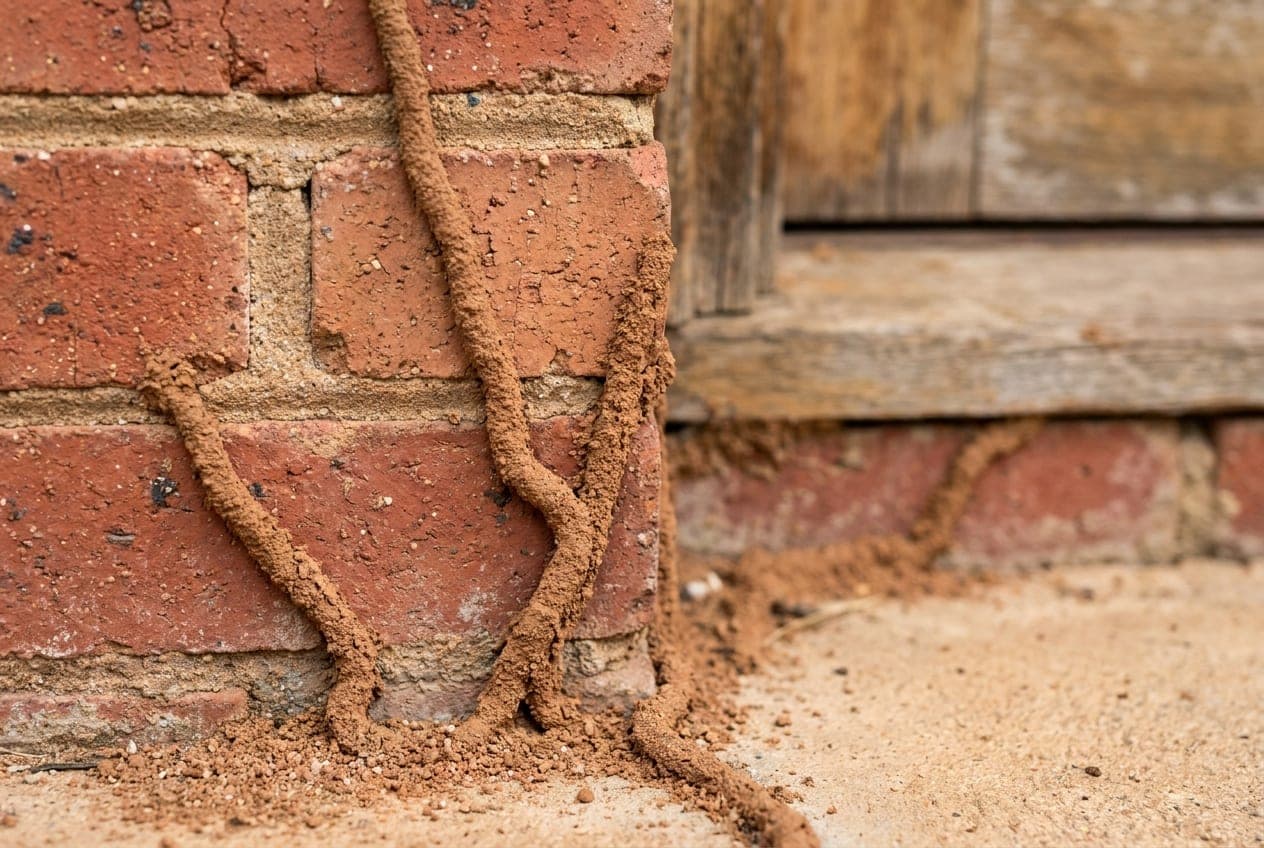
Termite mud tubes are narrow, pencil-width tunnels made of soil, chewed timber and termite saliva, built to shield subterranean termites from open air and predators as they travel between the ground and a timber food source. If you see one on a foundation wall, stump or pipe in Adelaide, it means an active colony has almost certainly found a way into your home, and it needs a proper inspection, not a broken-off patch job.
What a mud tube is actually made of
A mud tube isn't dirt someone tracked up the wall. It's a purpose-built structure, mixed from soil particles, digested wood fibre and termite saliva into a paste that hardens into a protective shell. Subterranean termites (the species responsible for the vast majority of structural damage across Adelaide) need constant moisture and darkness to survive. Unlike ants or drywood termites, they cannot cross open, dry surfaces safely, so they build these tubes as covered highways between their underground nest and whatever timber they're feeding on above ground.
That's the key detail: a mud tube is not damage in itself, it's infrastructure. Its presence tells you termites have already established a supply route into the structure, and that timber somewhere along that route is being consumed right now.
Mud tubes vs cracks, stains and mortar droppings
The most common false alarm we hear about is a homeowner mistaking a rendering flaw, an old mortar smear, or a dirt stain from irrigation overspray for a mud tube. The distinction is texture and shape. A mud tube has a rounded, slightly raised profile, roughly pencil-width and fairly consistent along its length, and it will usually run in a continuous line from soil level upward rather than sitting as an isolated blob or patch. Mortar droppings from original construction tend to be flatter, irregular in width, and don't connect back down to the soil. If you gently press a section (without breaking it) and it has a slightly soft, packed texture rather than the hard set of mortar, that's another indicator worth noting before you call anyone out.
Where to look on an Adelaide home
Mud tubes turn up in fairly predictable spots, and knowing the pattern helps you check the right places instead of guessing.
External foundations and slab edges
The most common location is the join between the soil and the base of a brick or rendered wall. South Australia's reactive clay soils shrink hard in summer and swell again with autumn rain, opening fine cracks right at the slab edge. Termites exploit those cracks as a ready-made entry point, and the tubes often trace the exact line of a shrinkage crack rather than running in a straight path. That's a specifically local pattern: homes on the clay-heavy soils common through the northern and eastern suburbs tend to show tube activity following seasonal ground movement, not just the shortest route to timber.
Subfloor piers and stumps
In older Adelaide homes with timber or brick pier subfloors, tubes commonly run up the outside face of a stump or pier, heading straight for bearers and floor joists. These are often invisible unless someone is actually down in the subfloor with a torch, which is exactly why front-of-house symptoms like a sagging floor or a sticking door tend to appear well after the tube has been active for some time.
Retaining walls, garden beds and fence posts
Anywhere timber sits close to damp soil is a candidate. Retaining walls backed against a garden bed, timber fence posts, and even stacked firewood against an external wall are common secondary tube locations, and they're worth checking alongside the main structure. For more on this pattern, see where termites hide in your home.
Inside wall cavities and behind skirting
Less visible again, tubes can run up inside brick veneer cavities or behind plasterboard, only becoming apparent when a small section of skirting or render is removed. This is one of several reasons a visual check from the outside is never the full picture, and why a subfloor and roof void inspection matters as much as a walk around the garden.
Exposed tubes across open ground
Occasionally you'll spot a freestanding tube running across an open surface such as a concrete path, a paved courtyard or the face of an exposed brick pier with no obvious crack to follow. These "exploratory" tubes are built when termites are testing new territory rather than following an existing entry point, and their presence away from an obvious crack or gap can actually indicate a larger, more established colony nearby, since building a tube across open ground takes more effort and exposes the workers to more risk.
What a mud tube tells you (and what it doesn't)
Finding a tube confirms termite activity has reached that point on the structure. What it doesn't tell you, without a proper inspection, is how far the colony has spread, whether the tube is currently active, or how much timber has already been compromised. A tube that's dry and crumbles at a touch might mean the termites have moved off that particular route, but the colony is very likely still established somewhere in the yard or subfloor. Complacency at this point is the single most common mistake we see: homeowners knock the tube down, assume the problem solved itself, and don't get an inspection booked. For a broader list of the errors people make with early warning signs, see 12 signs you have termites (and what to do next).
The CSIRO's timber pest research has long identified subterranean termites, largely the destructive Coptotermes species, as the dominant termite risk to Australian homes, precisely because of their tube-building, moisture-dependent foraging behaviour. That biology is exactly why tubes appear where they do, and why treatment needs to target the colony's access routes rather than just the visible timber damage.
What to do if you find one
Leave the tube intact. Take a clear photo for reference, note the location, and avoid scraping or breaking it open, since disturbing an active tube can cause the colony to relocate its foraging route rather than solving anything. From there, the sensible next step is a proper inspection rather than a guess. Our do I have termites? checker is a fast way to work out whether what you're seeing lines up with typical termite activity before you book anyone out.
If activity is confirmed, termite treatment needs to address both the existing colony and the entry points the tubes represent, which is a job for a licensed technician working to the relevant Australian Standard for termite management, not a DIY spray-and-hope approach. We connect Adelaide homeowners with licensed, vetted local technicians who can assess the extent of activity properly and recommend a treatment matched to your home's construction and soil conditions.
The bottom line
A mud tube on your foundation, stump or retaining wall is one of the clearest, most reliable signs of an active termite colony you'll find without professional equipment. It's not a reason to panic, but it is a reason to act: leave it undisturbed, get it assessed properly, and treat the underlying colony rather than the symptom you can see on the surface.
Ready to get quotes from licensed technicians?
Tell us about your problem and we match you with a vetted local operator. Free, no obligation.
Get free quotesFrequently asked questions
They look like thin, raised lines of compacted soil roughly the width of a pencil, running vertically up a foundation wall, pier, stump or pipe. Colour ranges from grey to reddish brown depending on the soil they were built from, and the surface has a slightly grainy, crumbly texture rather than the smooth finish of a stain or a crack.
It is best not to. Breaking a tube open can send the colony deeper into the subfloor or further into the timber frame, making the eventual treatment harder to target. If you have found a tube, photograph it, leave it intact and get a licensed technician out to inspect it properly.
Not necessarily. Termites abandon tubes when a food source is exhausted or conditions change, but the colony itself is usually still active somewhere nearby in the soil. A dry tube is a sign to get a full inspection done, not a sign to relax.
No. They are most visible on external foundations, but the same tubes commonly run up subfloor piers, inside wall cavities, behind skirting boards, and up the inside face of brick veneer where they are completely hidden from view until damage is well advanced.