Termite Damage vs Water Damage: How to Tell
Termite damage vs water damage explained: the texture, sound and pattern differences Adelaide homeowners can check before assuming the worst.
Key takeaways
- Termite damage runs along the grain in layered galleries; water damage swells, cups and separates across the grain.
- Water-damaged timber stays a consistent soft, spongy texture throughout; termite-damaged timber is often solid on the surface and hollow underneath.
- A moisture meter reading high does not rule out termites: leaking pipes and termite activity often show up in the same spot because both love damp subfloors.
- If you cannot tell the difference by sight or sound, do not open the wall or skirting yourself. Get it checked before you disturb anything.
Termite damage and water damage look similar at a glance, but the difference comes down to pattern and texture: termite damage follows the timber's grain in tunnelled, layered galleries and often leaves a hollow shell with a solid-looking surface, while water damage swells, cups, discolours and softens timber more evenly across the grain. Tapping the timber and checking whether the damage tracks with a known leak are the two fastest ways to tell them apart.
For Adelaide homeowners, this distinction matters more than it might seem. Misreading termite galleries as an old plumbing stain, or assuming a leak is "just termites," both lead to the wrong next step, and either mistake can cost thousands in delayed repairs. Here is how to read the timber correctly before you call anyone.
Why the confusion happens in the first place
Termites and moisture both target the same weak points in a house: skirting boards near bathrooms, architraves under leaking window frames, subfloor bearers close to garden beds, and timber framing behind older, poorly flashed brickwork. Adelaide's mix of ageing bungalows, sandstone-and-brick villas and newer builds on reactive clay soils means both problems are common, and they frequently show up in the exact same 30cm section of skirting.
That overlap is the trap. A homeowner sees a stained, slightly swollen skirting board near a bathroom and assumes it is a slow leak, because that is the obvious explanation. Meanwhile the timber has actually been hollowed out by termites who were drawn there by the same moisture. Read about what termite damage actually looks like before you settle on either diagnosis.
The texture test: hollow vs soft
This is the most reliable difference you can check yourself, carefully, without cutting into anything.
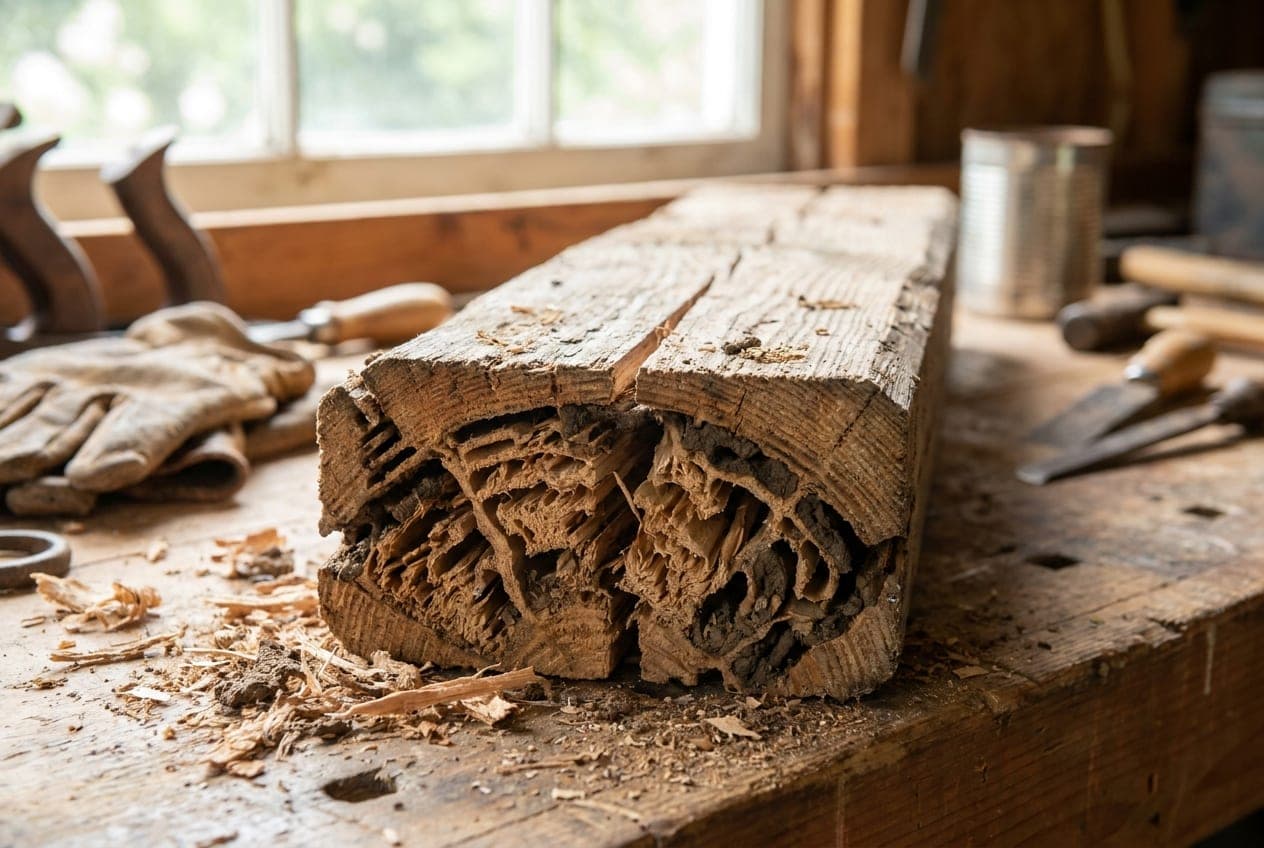
Termite damage typically leaves the surface layer of timber intact while the inside is eaten away in a honeycomb or layered pattern along the grain. Tap it with a knuckle or the handle of a screwdriver: it sounds hollow, papery or drum-like, and the surface can look almost normal until it is pressed and gives way.
Water damage softens timber more uniformly. It swells, the grain lifts and separates (often called "cupping" or "checking"), and the wood feels spongy or crumbly right through, not just underneath a thin shell. Paint or laminate over water-damaged timber tends to bubble evenly rather than in the patchy way termite tunnelling can create.
If you press a screwdriver into a suspect area and it sinks into something like sawdust with almost no resistance, and the surrounding timber feels similarly soft, that leans towards water. If the surface resists then suddenly collapses into a hollow void, that leans towards termites.
The pattern test: along the grain vs across it
Termite galleries run with the grain, because termites eat along the softer spring-growth layers of the timber and leave the harder layers as thin walls between tunnels. If you can see into a damaged section, look for parallel channels or a laminated, layered appearance running in one direction.
Water damage does not follow the grain in the same disciplined way. It tends to cause the timber to swell and separate across multiple planes, warping boards, lifting skirting away from the wall, or causing floorboards to cup upward at the edges. Discolouration from water is usually a stain that fans outward from the source, rather than a tunnel network.
Where the two get mixed up most in Adelaide homes
Subfloor bearers and joists
Adelaide's stock of homes with timber subfloors and limited ventilation is exactly the environment termites and rot both favour. A damp, poorly ventilated subfloor can produce fungal decay (soft, crumbly, often dark timber) right alongside active termite galleries in the same bearer. Rot alone does not mean termites, but the conditions that cause one make the other more likely. If you are checking under an older Adelaide house, read up on subfloor ventilation and termite risk first, since it explains why this specific combination is so common locally.
Bathroom and laundry skirting
Skirting boards near wet areas are a classic overlap zone. A grouting failure or a slow leak from a shower base can wick moisture into the skirting for months before anyone notices a stain. That same moisture is an open invitation for termites working up from the subfloor. Do not assume the visible staining explains everything underneath it.
Window frames and architraves
Poorly sealed or ageing window flashing is common in Adelaide's older brick-veneer stock, and it produces water staining on architraves that looks, at a glance, exactly like early termite damage: slight swelling, a faint hollow sound, discoloured paint. The only way to know which one you are dealing with is to open the area (or have someone qualified do it) and look at the internal pattern.
When appearance alone will not settle it
Sometimes the surface evidence is genuinely ambiguous, especially in early-stage damage where neither the hollow-shell pattern nor the swelling is pronounced yet. In that case, do not rely on a moisture meter reading by itself. A high moisture reading confirms dampness, not termites, since CSIRO's guidance on termite management makes clear that moisture is simply one of several conditions that increase termite pressure around a structure, not a diagnostic test in its own right. The Australian Building Codes Board's timber pest management standard (AS 3660) is the technical reference tradespeople and inspectors work from when assessing conducive conditions and damage, and it treats visual pattern, hollowness and moisture as separate lines of evidence, not one substitute for another.
This is also where a first-hand quirk of Adelaide construction matters: many older Adelaide homes were built with cypress pine or treated pine skirting that naturally has a slightly fibrous, layered grain. Homeowners sometimes mistake the timber's natural grain pattern for termite galleries, or vice versa, because both can look "layered" from a distance. That specific misread is common enough locally that it is worth not trusting your own eye alone if you are uncertain.
What to do if you are still not sure
If you have found soft, hollow or discoloured timber and cannot confidently tell which cause is at play, the safest move is to leave the area undisturbed. Do not pry back skirting, do not keep pressing on the timber, and do not attempt to "dig out" the affected section. If it is termites, disturbing the gallery can send the colony deeper into the structure or into a different part of the house, making the eventual termite treatment harder to target. If it is water damage, disturbing it will not change the outcome but you risk masking evidence a tradesperson needs to see intact.
The faster and more accurate path is to run the do I have termites checker against what you are seeing, then get it looked at properly. We connect you with licensed Adelaide technicians who inspect the area, confirm which of the two you are dealing with (or both), and explain what happens next. For the broader picture on how to spot an active infestation before it gets to this stage, see 12 signs you have termites and hollow-sounding timber and other early warning signs.
The bottom line
Termite damage and water damage are diagnosed differently, but they are found in the same places for the same underlying reason: moisture. Learn the hollow-vs-soft texture test and the along-the-grain-vs-across-it pattern test, treat a moisture meter reading as one clue rather than an answer, and get a professional opinion whenever the two could plausibly be either one. Guessing wrong in either direction costs more than the inspection would have.
Ready to get quotes from licensed technicians?
Tell us about your problem and we match you with a vetted local operator. Free, no obligation.
Get free quotesFrequently asked questions
Yes, and it is common in Adelaide's older homes. A slow leak creates the moist timber termites prefer, so a damp skirting board or architrave can carry both problems at once. That overlap is exactly why a visual guess is not reliable.
No. A moisture meter only measures water content in the timber. High readings are common with both plumbing leaks and termite activity, since termites need moisture to survive. It is a useful tool for a technician but not a standalone diagnosis.
Not necessarily. Termites feeding just behind painted plasterboard or timber can create the same bubbling and rippling look as a leak, because both push moisture and softened material against the surface. The paint alone will not tell you which one it is.
Avoid pressing on it further, prying it open or pulling back skirting, since disturbing a termite gallery can scatter the colony before an inspection. Note the location and get a professional assessment rather than guessing.