Termites vs White Ants: Are They the Same?
Termites vs white ants: the same insect, 2 different names. Learn why Australians still call termites white ants, and why the label change does not.
Key takeaways
- White ants and termites are the same insect. There is no biological difference, only an old common name that stuck in Australian usage.
- Termites are more closely related to cockroaches than to true ants, which is why entomologists dropped white ant as a scientific term decades ago.
- The confusion causes real problems when homeowners search for the wrong pest and end up buying ant bait that does nothing against a termite colony.
- Adelaide's older bungalows and stumped homes are exactly the style where the white ant label still gets used, often by the very homeowners most at risk.
Termites and white ants are the same insect. White ant is an older common name that stuck in Australian and British usage long after entomologists reclassified termites as being far more closely related to cockroaches than to true ants. If someone tells you they have white ants in the subfloor, they mean termites, full stop.
The mix-up sounds trivial until it changes what someone actually does about it. Homeowners who grew up hearing "white ants" from a parent or grandparent sometimes go looking for ant treatment when they should be looking for termite treatment. Ant bait stations, ant sprays, and general insecticide have no meaningful effect on a subterranean termite colony, so a homeowner acting on the wrong name can lose weeks treating the wrong problem while the real one keeps eating timber underneath the house.
Where the name white ant actually came from
Early European settlers and naturalists in Australia and other parts of the British Empire encountered termites long before modern entomology had sorted insects into their proper families. Termites are pale, soft-bodied, live in large organised colonies, and have distinct worker and soldier castes, all traits that look ant-like at a glance. The label white ant stuck across everyday speech even after scientists confirmed termites belong to the order Blattodea, the same order as cockroaches, not to Hymenoptera, the order that contains true ants, bees, and wasps. Australia's CSIRO and university entomology departments have used the term termite as standard for well over a century, but the older name never fully disappeared from household conversation, especially among generations who learned it from their parents.
Older pest control advertising did not help. Well into the mid-1900s, tradesperson signage and local newspaper classifieds around Adelaide still advertised white ant destruction rather than termite treatment, which reinforced the name in the exact households now old enough to be at the highest structural risk. It is a naming quirk with a long paper trail, not a modern mistake, which is part of why it has proven so durable.
The real differences between termites and true ants
A termite and a flying ant look similar for about 2 seconds, then the differences are clear if you know what to check.
Body shape
Termites have a thick, uniform waist running from thorax to abdomen. True ants have a distinctly pinched, narrow waist that gives them their classic ant silhouette.
Antennae
Termites have straight, bead-like antennae. Ants have antennae that bend at a sharp angle partway along their length, often described as elbowed.
Wings
Winged termites (alates) have 2 pairs of wings that are equal in length and extend well past the body. Flying ants have 2 pairs too, but the front pair is noticeably longer than the back pair.
Colony behaviour
Termites feed on cellulose (timber, paper, cardboard) and cause structural damage over time. Most ant species found around Adelaide homes are a nuisance in kitchens and gardens but do not eat structural timber. This is the practical difference that actually matters to a homeowner: one costs you a service call, the other can cost you a subfloor.
What a swarm actually tells you
Both termites and ants produce winged reproductives that swarm on warm, still evenings, usually after rain, which is exactly the moment most people try to identify what they are looking at and get it wrong. A termite swarm tends to be short-lived, with wings shed almost immediately once the insects land, leaving small piles of uniform, translucent wings near lights or windowsills. An ant swarm behaves similarly but the individual insects are more active and mobile afterwards rather than shedding wings and settling. If you catch a swarm in progress, resist the urge to spray it before checking body shape and wing length. Spraying a termite swarm rarely reaches the colony that produced it, since alates are only a small fraction of a mature nest's population.
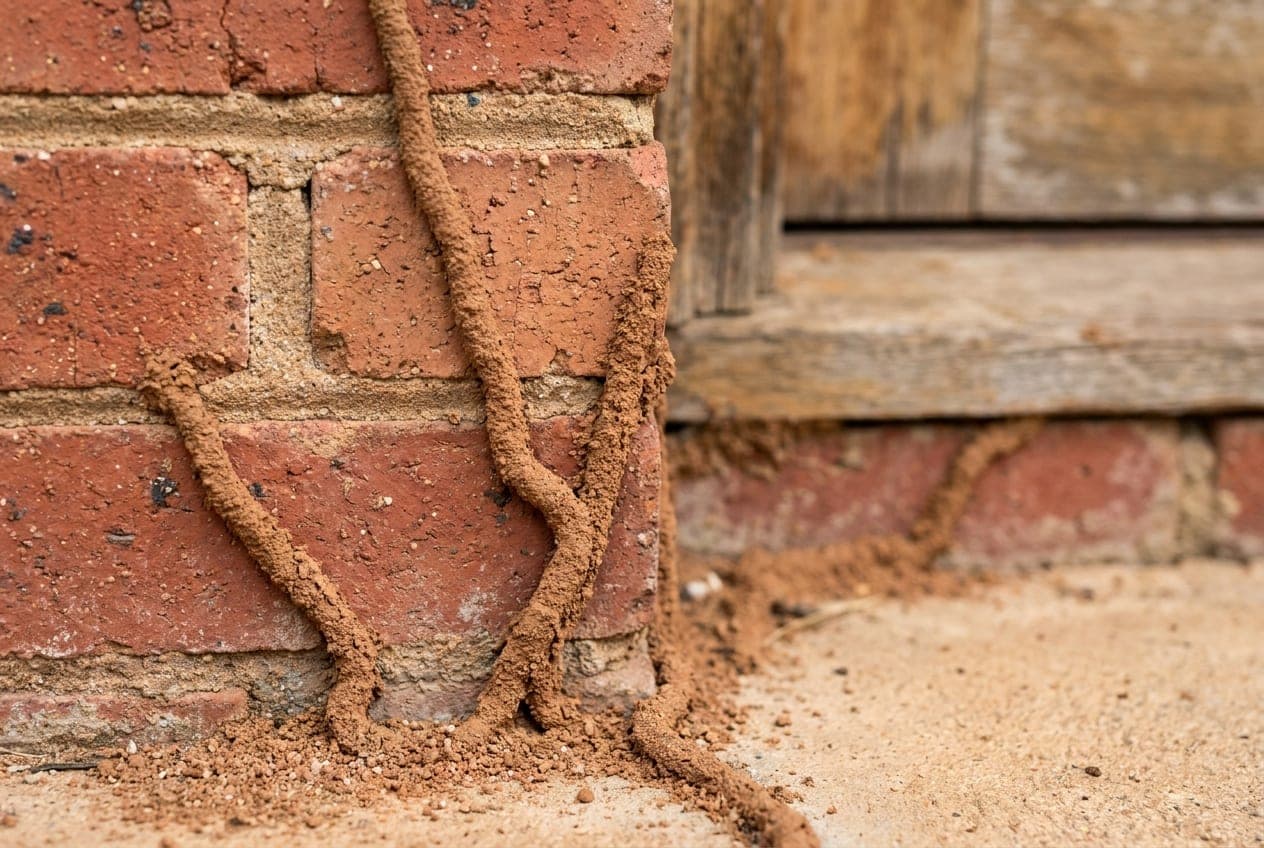
If you are trying to work out which one you are looking at right now, our guide to 12 signs you have termites (and what to do next) walks through the physical evidence, mud tubes, hollow timber, discarded wings, that points specifically to termites rather than ants.
Why this confusion still shows up in Adelaide specifically
Adelaide has an unusually high proportion of homes built before the 1970s, particularly through the western suburbs, the inner south, and older pockets of the Adelaide Hills. Bungalow and villa owners in these areas are more likely to have inherited the white ant terminology directly from parents or grandparents who owned the same house, because these are also the homes with stumped subfloors and ageing timber most exposed to termite risk in the first place. The pattern is almost circular: the housing stock most likely to need a termite check is also the housing stock where the outdated name is most likely to still be in use. It is worth deliberately using the word termite when you search, ask a tradesperson, or read a product label, simply because "white ant treatment" is not a category that exists in modern pest control, and searching for it can lead to irrelevant results or, worse, the wrong shelf at the hardware store.
There are multiple termite species active across South Australia with slightly different habits and risk profiles, covered in more detail in common termite species in South Australia. None of them are ants, whichever name your neighbour uses.
What to do if you are not sure which one you have
The safest approach if you spot a swarm, mud tubes, or timber damage and are not certain which pest is responsible is to avoid disturbing whatever you found and get it properly assessed rather than guessing from a description. Start with the do I have termites checker to get a quick read on how urgent your situation looks based on what you are seeing. The CSIRO also maintains general background on termite biology and Australian species if you want the underlying science behind the classification.
If the signs point to termites rather than garden-variety ants, the next step is a proper inspection rather than a trip to the hardware store. We connect Adelaide homeowners with licensed local technicians through our termite treatment service, matched to your suburb, your home's construction type, and whether what you are dealing with needs a barrier, baiting, or just a clear answer either way.
Ready to get quotes from licensed technicians?
Tell us about your problem and we match you with a vetted local operator. Free, no obligation.
Get free quotesFrequently asked questions
Yes. White ant is simply the old common name Australians and British colonists used for termites before the scientific term became standard. There is no separate insect called a white ant. If someone mentions white ants in the roof or under the house, they mean termites.
Termites are pale, soft-bodied, and live in organised colonies with workers, soldiers, and a queen, which made them look and behave like ants to early observers. Genetically, termites sit closer to cockroaches. The resemblance to ants is only superficial, but the name outlasted the science.
It matters for search results and product shopping more than for the pest itself. Ant baits and ant sprays sold at hardware stores are built for true ants and will not control a termite colony. Searching or asking specifically for termite treatment gets you the right product and the right licensed technician.
Usually, yes, with a close look. Termites have a thick waist, straight antennae, and wings of equal length. Flying ants have a pinched waist, bent antennae, and 2 different wing lengths. It is a useful check before assuming a swarm is termites, though a licensed inspection is the only way to be certain of an active colony.