What Happens During a Termite Treatment (Step by Step)
A termite treatment involves inspection, drilling or trenching, chemical application and a final check. Here is exactly what happens during termite treatment, start to finish.
Key takeaways
- A termite treatment day typically runs 4 to 8 hours and covers inspection, drilling or trenching, chemical or bait application, and a final walkthrough.
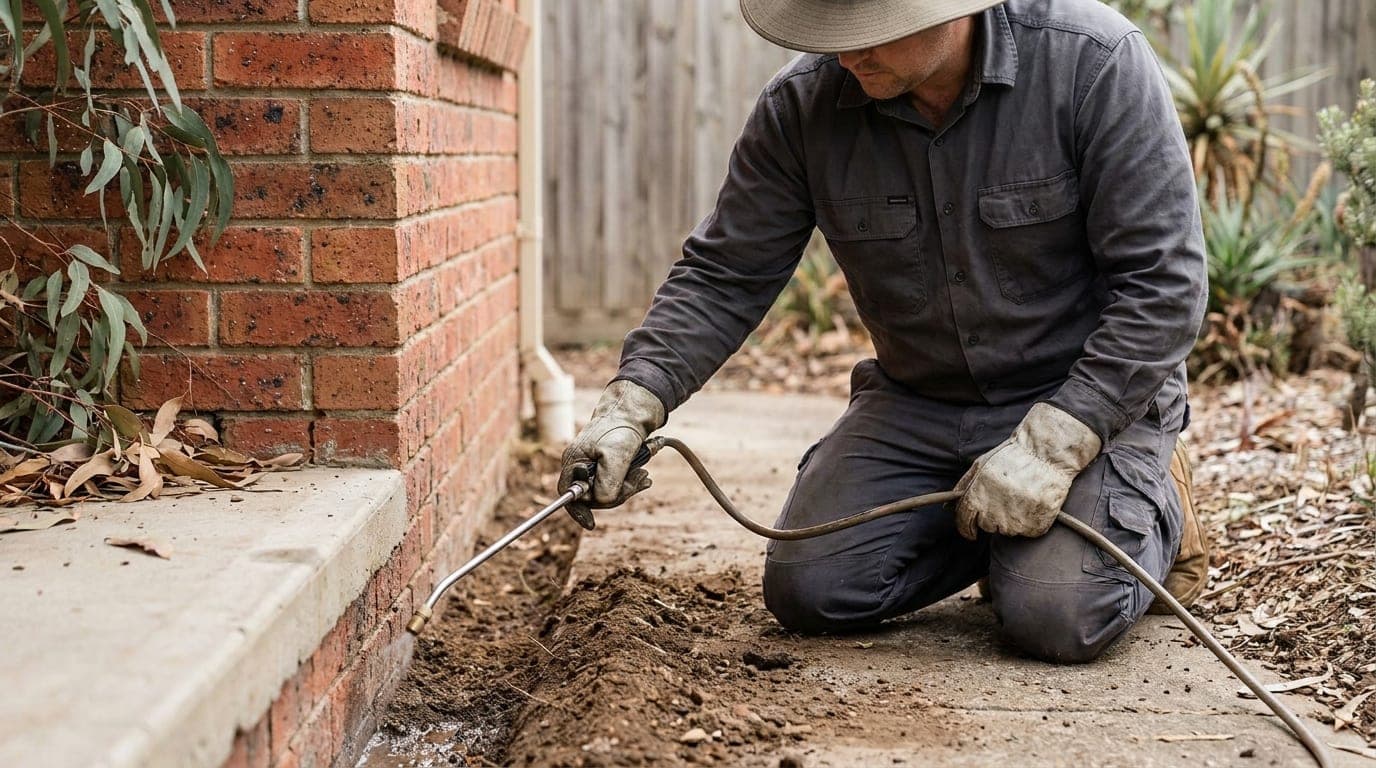
- Chemical barrier treatment involves trenching around the perimeter and drilling through concrete slabs, paths and driveways at set intervals, then injecting a termiticide.
- You do not need to vacate the house during most treatments, but pets should be kept away from wet trench lines for the first few hours.
- The licensed technician we match you with will document every drill point and treatment zone, which matters later for warranty claims.
- Baiting systems are a different day entirely: stations go into the ground around the property with no drilling into the home itself.
A termite treatment day runs 4 to 8 hours depending on the size of your home and which method is used, and it moves through 4 stages: a pre-treatment inspection, drilling or trenching around the structure, chemical or bait application, and a final check with documentation. Most Adelaide homes need chemical soil barrier work, which is the most invasive of the options but also the most immediate in effect.
Homeowners rarely ask about termites until they have already found mud tubes on a foundation wall or a hollow-sounding skirting board, and by then the question shifts fast from "do I have termites" to "what is about to happen to my house". This is worth answering plainly, because the day itself is more mechanical and less disruptive than most people expect.
Before the technician arrives
Every termite job starts with a scoped inspection, not a guess. The licensed technician we match you with will walk the perimeter, check the subfloor if there is access, and identify active workings, moisture sources and construction details that affect where the barrier needs to go. Adelaide's older bluestone and sandstone cottages, especially through the western suburbs and inner south, often have solid masonry footings with no clear slab edge, which changes the drilling pattern completely compared to a 1990s brick veneer in the northern suburbs. This is the detail that separates a proper job from a template one: a treatment plan copied from a standard project home does not work on a cottage with a stone rubble foundation, because there is no continuous concrete edge to drill along in the first place.
If your home already has chemical soil barrier treatment installed from a previous job, the technician will check its condition and age before deciding whether to reinstate sections or start fresh. You can read more on how termite treatment works across the different methods if you want the mechanics before the day itself.
Trenching and drilling: the part people worry about most
For a chemical barrier, the crew digs a trench roughly 150mm to 200mm deep around the external perimeter of the house, following the line of the footings. Where the trench meets a slab, path, driveway or the base of a wall, they drill a series of holes at set intervals (usually every 300mm) straight down to the footing depth. This is the loudest and messiest-looking part of the day, and it is also the part that gives people the wrong impression: the drilling does not damage the structure. Holes are small, typically 10mm to 14mm, and get filled and capped afterward to match the surrounding concrete or paving as closely as possible.
Internal drilling happens where there are expansion joints, internal walls sitting on slab, or plumbing penetrations that could otherwise give termites a hidden path under the barrier. Not every home needs internal drilling. A single-storey home with a simple rectangular footprint might only need perimeter work, while an extended or renovated home with multiple slab pours often needs internal points to close the gaps between them.
Applying the termiticide
Once trenching and drilling are done, the termiticide goes in. Liquid non-repellent chemicals are the standard now over the older repellent products, because termites cannot detect them and carry the active ingredient back into the colony on contact, which affects more of the nest than direct contact treatment alone. The chemical is mixed on site to the label rate and applied into the trench and down each drill hole until the soil is saturated to the correct depth, then the trench is backfilled and the drill holes are capped.
This is also where reticulation systems differ. If your home has a termite reticulation system built in during construction, the technician connects to the existing station network and pumps the chemical through pre-laid pipework instead of drilling fresh holes, which is faster and less disruptive for homes that had the system installed at build stage.
Baiting day looks completely different
If a termite baiting system is the chosen method instead of a barrier, the day looks nothing like the above. Bait stations go into the ground at intervals around the property, usually every 3 to 4 metres, with no drilling into the slab or footings at all. It is a much quieter, less physically invasive day, but it is also a slower-acting method: baiting relies on foraging termites finding the station and carrying the active ingredient back to the colony over weeks, not hours. Which method suits your home depends on construction type, budget and whether termites are already active. Read the comparison in barrier vs baiting if you have not settled on a method yet.
What happens to the house and the people in it
You do not need to leave the property during most treatments. The chemicals used in registered barrier products are formulated to bind to soil and dry inertly, and once a treated area is dry (generally within a few hours) it poses no ongoing exposure risk, a standard consistent with the APVMA's registration requirements for termiticide products used in Australian homes. Keep pets and kids away from wet trench lines and open drill holes until the crew confirms everything is capped and dry. If you have an edible garden bed sitting hard against the foundation, mention it before the day starts. Adelaide's compact suburban blocks mean garden beds are frequently built right up against the house, closer than the standard product label anticipates, and the treatment plan needs to account for that instead of just running the line straight through it. If you are weighing up whether pets and kids are fully in the clear, is termite treatment safe for kids and pets goes into more detail on this specific concern.
The final walkthrough and documentation
At the end of the job, the technician does a final walkthrough with you, confirms every drill hole is filled and capped, and hands over documentation showing exactly where the barrier runs, what product was used, and at what concentration. Keep this paperwork. It is the record that matters if you ever need to make a claim under a termite treatment warranty, and it is also what any future termite inspector will ask for to understand what protection is already in place before recommending further work.
If you are trying to work out where the cost sits before booking, the termite treatment cost guide breaks down what affects the price for a job like this in Adelaide. For homes that already have visible activity, treatment usually needs to happen quickly rather than being scheduled around convenience, since colonies do not pause while quotes are compared, a point CSIRO research on subterranean termites in Australian buildings backs up: a continuous treated zone is what stops them, and any gap in that zone is simply a path around it. For a full comparison of what a job like this costs, and what drives the price up or down, see termite treatment.
Ready to get quotes from licensed technicians?
Tell us about your problem and we match you with a vetted local operator. Free, no obligation.
Get free quotesFrequently asked questions
No. Most chemical barrier and baiting treatments are done with residents staying in the home. Keep pets and children clear of wet trench lines and open drill points until the crew confirms the area is dry and capped, usually within a few hours.
The drill holes are small (around 10mm to 14mm) and get filled and colour-matched afterward. They do not compromise the structural integrity of a slab, path or driveway when placed and filled correctly by a licensed technician.
Most residential chemical barrier jobs take 4 to 8 hours depending on the size and layout of the home. Baiting station installation is often quicker since there is no drilling involved, but the results take longer to show since it relies on termites finding the stations.
Clear garden beds and mulch away from the foundation line where practical, move stored items away from external walls, and make sure subfloor and internal access points are reachable. Mention any edible gardens hard against the house so the treatment plan can account for them.