Landscaping and Mulch Mistakes That Attract Termites
Mulch and termites are closely linked because organic mulch holds moisture and cellulose against your foundation. Learn the Adelaide landscaping mistakes to avoid.
Key takeaways
- Organic mulch piled against a foundation wall gives termites moisture, warmth and a direct bridge onto your property, all in one garden bed.
- The danger is not the mulch type alone, it is the depth and the gap (or lack of one) between the mulch and the weep holes or timber cladding.
- Adelaide's clay soils crack and swell with our dry summers and wet winters, so garden beds that bank soil or mulch above the damp course are a common and avoidable trigger.
- A 75mm to 100mm inspection gap between mulch, soil or paving and the weep holes is the single easiest landscaping fix available to any homeowner.
Mulch and termites are linked because organic mulch against a foundation wall stacks the 3 things a colony needs most: constant moisture, insulation from temperature swings, and a concealed bridge straight onto the timber in your home. It does not cause termites to appear, but it makes an existing colony's job dramatically easier, which is why so many Adelaide termite finds trace back to a garden bed.
Why mulch is such a reliable termite magnet
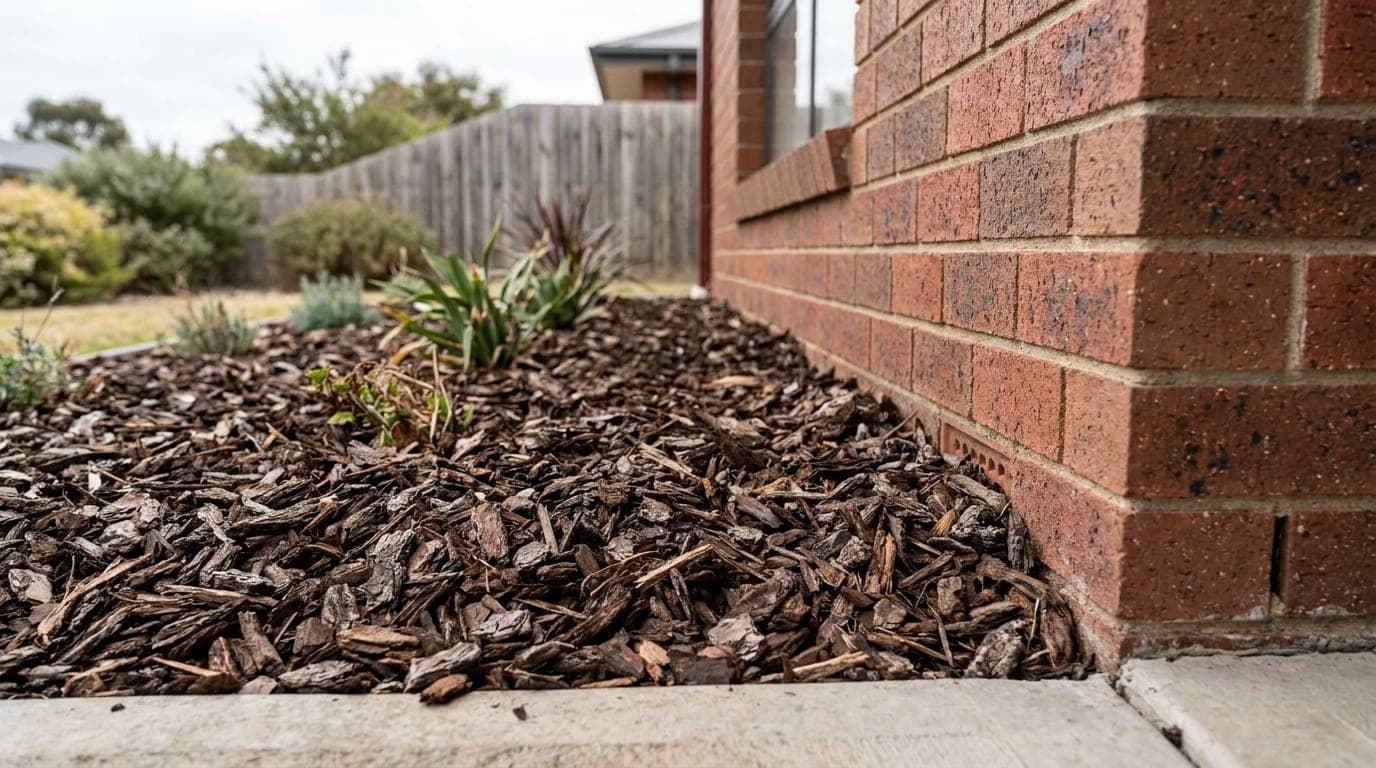
Termites are subterranean insects that die quickly if exposed to open air and sunlight, so everything about their behaviour is built around staying hidden and staying damp. A garden bed banked up against a house wall gives them exactly that: shade, retained moisture from watering or rain, and a soft medium they can tunnel through without ever breaking the surface. Worse, mulch piled higher than the weep holes (the small gaps at the base of a brick veneer wall) or above the visible concrete slab edge hides the one place a technician, or you, would otherwise spot a mud tube forming.
This is the counterintuitive part most Adelaide homeowners miss: it is rarely the mulch ingredient itself that causes the problem. Pine bark, sugar cane and eucalyptus mulch all behave similarly once compacted and damp. The real issue is depth and placement, specifically mulch that touches or covers the gap between the ground and the house that is meant to stay open and inspectable. Two identical garden beds, one raked back to expose the slab edge and one banked up against the cladding, carry very different risk profiles even though the mulch product itself is the same bag from the same nursery.
The Adelaide-specific pattern we see in garden design
Adelaide's clay-heavy soils in suburbs across the plains, and the sandier profiles closer to the coast, both swell and shrink hard across our dry summers and wet winters. Landscapers compensate by building up garden beds to stop water pooling near the house, which is sound drainage advice on its own, but it routinely ends with soil and mulch levels creeping above the damp course or weep holes without anyone noticing over a few seasons of top-ups. It is a slow creep, not a single bad decision, which is exactly why it goes unnoticed until an inspection or a swarm forces the issue. Older bungalows in the western suburbs with low-set brick veneer are especially exposed, because their weep holes sit only a few courses above ground level to begin with, leaving very little margin once a garden bed is topped up even once or twice. If you want the full context on how our climate and soil interact with termite pressure, the termite prevention guide for Adelaide homes covers this in more depth, and homeowners in the eastern suburbs and foothills should also read up on why Adelaide Hills properties carry extra pressure from denser vegetation and retained bushland moisture.
The landscaping mistakes to check for
Garden beds built up against the wall
Raised garden beds look tidy and help with drainage away from paths, but if the soil or mulch level sits above the weep holes, you have removed your own early-warning system and given termites a sheltered climb straight to the timber frame.
Mulch piled deeper than 75mm
A thin, well-maintained layer of mulch is a normal part of Adelaide gardens. The risk starts when mulch is topped up year after year without ever being raked back, until it sits 150mm or more deep and permanently damp underneath.
Timber sleepers used as garden edging
Untreated or reused timber sleepers laid directly against soil are, in effect, a free meal placed at ground level next to your home. If they are also touching the house wall, they double as a bridge.
Dense planting hard against the foundation
Shrubs and climbers planted tight against a wall trap humidity, block airflow, and make it physically difficult to inspect the slab edge, which is the exact combination termites favour.
Irrigation and downpipes discharging into garden beds near the house
Constant dampness from a dripper line or a downpipe emptying straight into a foundation garden bed does the same job as mulch, it just adds the moisture side of the equation directly.
What good landscaping looks like instead
The fix is not to rip out garden beds, it is to keep a visible, dry inspection zone between plantings and the house. Aim for a 75mm to 100mm clearance below weep holes and cladding, slope garden beds away from the wall rather than banking them up, and switch to an inorganic mulch such as gravel or scoria in the strip closest to the house if you want the moisture-retention risk removed entirely while keeping organic mulch further out in the yard. None of this requires removing your existing landscaping design, just adjusting levels and clearances.
It is worth treating this the same way you would treat any other structural clearance on the property. Most homeowners would not accept a wall vent being permanently blocked by a storage box, yet the equivalent situation with a garden bed and a weep hole is common and rarely questioned, largely because mulch reads as a garden decision rather than a building one.
Why this matters more than most homeowners assume
A termite colony can cause structural damage well before any visible sign appears above ground, and a concealed garden bed is precisely the kind of entry point that delays detection by months or years. If your landscaping already has any of the patterns above, or you are simply due for a check, the do I have termites checker is a fast way to work out whether it is worth booking an inspection now rather than waiting for the next seasonal swarm. For anything beyond a visual check, we connect you with licensed Adelaide technicians through our termite control network, who can assess both the landscaping risk and the structure itself in the one visit.
According to the CSIRO's guidance on termite management, soil and moisture management around a building's perimeter is one of the most cost-effective, non-chemical steps a homeowner can take to reduce termite risk, and it costs nothing beyond an afternoon with a rake and a wheelbarrow.
The one habit worth adopting
Whenever you top up mulch, pull it back from the wall first, check the exposed strip for mud tubes or soft, hollow-sounding timber, then re-spread only after you have looked. It takes a couple of minutes and turns a routine gardening task into a genuinely useful, twice-yearly termite check, on top of whatever 10 termite mistakes homeowners typically make you might also want to rule out around the rest of the property.
Ready to get quotes from licensed technicians?
Tell us about your problem and we match you with a vetted local operator. Free, no obligation.
Get free quotesFrequently asked questions
Mulch does not summon termites from nowhere, but it makes an already-present colony's job far easier. Termites need moisture, warmth and a way to travel unseen. A thick layer of organic mulch against a wall delivers all three, so if termites are foraging nearby, a mulched garden bed against the house is one of the first places they will exploit.
Inorganic mulches like gravel, scoria or rubber chip do not feed termites the way bark or wood chip does, so they remove the food-source risk. They still need to be kept below weep holes and clear of timber, because termites can build mud tubes across gravel just as easily as they can across soil, they just will not eat it.
As a general rule, keep mulch, soil and garden beds at least 75mm to 100mm below any weep holes, air vents or timber cladding, and ideally set the bed back from the wall rather than banked up against it. This keeps the concrete slab edge or foundation visible, which is exactly what a licensed technician needs to see during an inspection.
Pull the mulch back from the wall so there is a clear, visible strip of foundation, and check for any mud tubes or damp patches while you are doing it. That single afternoon of garden work is the best immediate risk reduction, and it is worth following up with a professional inspection given how many Adelaide homes carry this exact setup without realising it.