Annual Termite Checks: Why Once a Year Matters
An annual termite check catches active colonies before they reach structural timber. Here is why once a year is the right interval for Adelaide homes.
Key takeaways
- An annual termite check is the interval insurers and timber-pest standards treat as minimum due diligence for most Adelaide homes.
- Reactive stumps, retaining walls and reticulated garden beds around Adelaide properties can hide activity that a visual walk-past will never catch.
- A proper inspection uses a moisture meter and often a termite detection device, not just a torch and a look under the house.
- Skipping a year does not save money if it turns a small localised treatment into a full structural remediation job.
The short answer
An annual termite check matters because termite colonies in Adelaide's soil and climate can establish and start damaging structural timber well inside a 12-month window, often with no visible external sign until the damage is already done. A yearly inspection is the interval that catches an active colony while the fix is still a small, localised job rather than a structural rebuild. It is also the interval most insurers and timber-pest standards treat as the minimum for keeping a home's protection current.
Why 12 months is the number, not 2 years or 5
Termites do not knock. A subterranean colony can move through soil, up a foundation wall, and into wall framing without ever breaking the surface of a skirting board. Adelaide's clay-heavy soils hold moisture against slab edges and stumps for long stretches after rain, which is exactly the condition termites need to keep tunnelling without drying out. Twelve months is roughly the window in which an undetected colony can go from "just arrived" to "has compromised a bearer or joist," which is why it is the interval written into most standard timber-pest inspection reports and the interval most home and contents insurers expect to see evidence of if a termite damage claim is ever lodged.
Stretch that to 2 or 3 years between checks and you are not saving money, you are gambling the difference between a spot chemical treatment and a full structural repair. If you are weighing that trade-off in dollar terms, it is worth reading how termite treatment prices actually move once damage (rather than just activity) is found.
What an inspection actually needs to cover in an Adelaide home
A drive-by look under the house with a torch is not an inspection, it is a glance. A proper annual check works through several zones most homeowners never think to check themselves.
Subfloor and stumps
Older Adelaide homes, particularly bungalows and villas through the western and inner suburbs, still run on timber stumps or a mix of timber and concrete. Timber stumps in contact with damp soil are a preferred termite entry point, and the underside of bearers is where early damage first shows.
Retaining walls and reticulated gardens
This is the one most homeowners get wrong, and it is worth being specific about. Adelaide's east-facing suburbs and hills-fringe blocks lean hard on retaining walls and terraced garden beds to manage slope, and those beds are almost always on an automatic reticulation system. Constant irrigation against a retaining wall that sits hard against the slab edge creates a permanently moist termite highway that a homeowner will never see, because the wall itself hides it from view on both sides. If your termite check only covers the subfloor and roof void and skips the retaining walls, it has missed one of the most common entry points in this city.
Roof void and roofline
Termites travelling via a roofline or a party wall is less common but not rare, especially in homes with disused chimneys or where a previous renovation left timber offcuts sitting in the ceiling space.
Fence lines and old stumps
Buried stumps, old fence posts and timber offcuts left in garden beds during a build are food sources that keep a colony fed close to the house without anyone noticing.
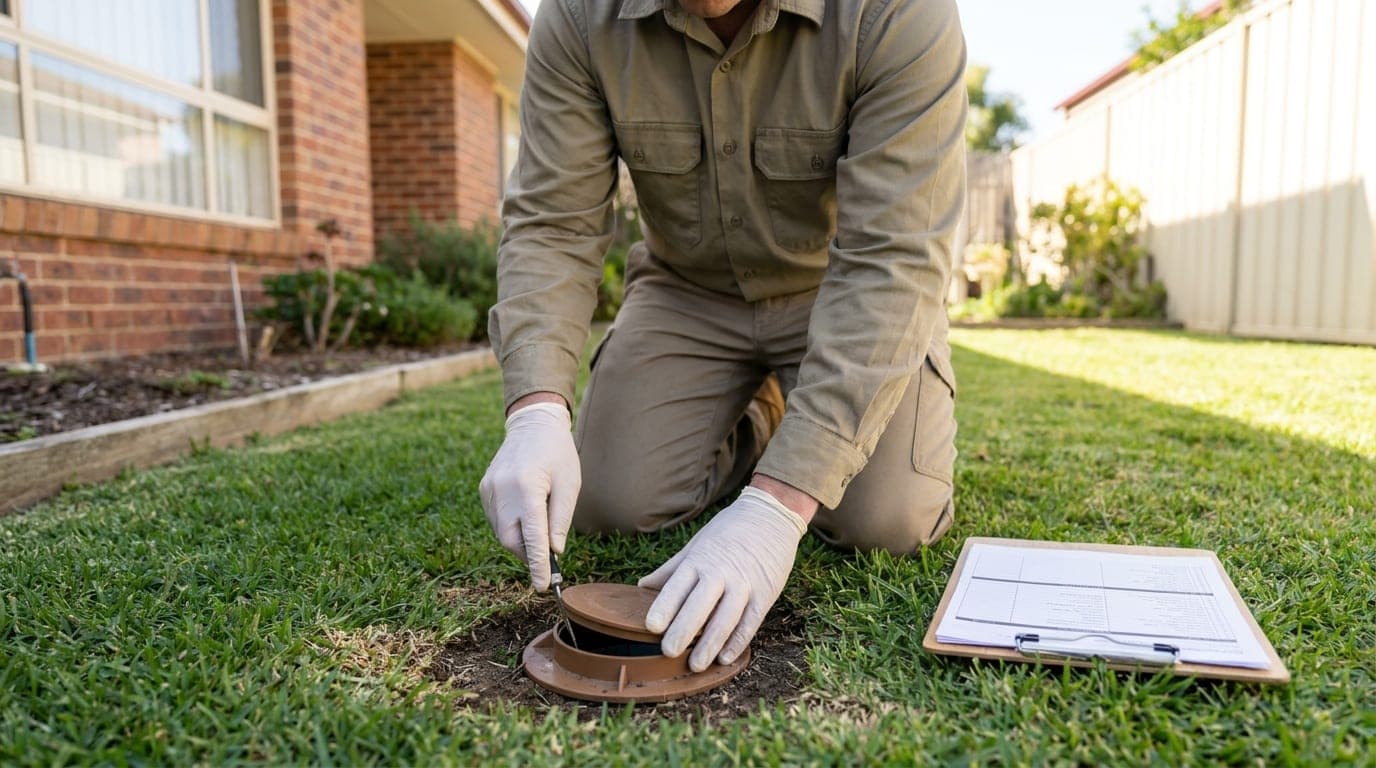
A technician doing this properly will also carry a moisture meter and, on timber that cannot be opened up or directly viewed, a termite detection device (radar or acoustic emission tool) to check for activity behind plasterboard and render without needing to cut into it. If you want the fuller picture on what tools and steps are involved, see how termite treatment works for the detection and treatment methods used once something is found.
The counterintuitive part: a new home needs this too
Most Adelaide homeowners assume a new build with a chemical barrier or reticulation system installed at construction is covered and does not need yearly checks. It is the opposite. A barrier has a rated working life, reticulation systems need their reservoirs topped up and tested, and building certifiers and SA planning conditions generally require the annual inspection to keep that system's protection certificate valid. Skipping the check because "it's a new house with a barrier" is one of the most common and costly assumptions we see. For more on how long that protection actually lasts, see termite barriers and how long they last.
If your home does not yet have a barrier or ongoing monitoring in place, it is worth reading how to prevent termites in your Adelaide home alongside your first inspection, since prevention and inspection work together rather than one replacing the other.
According to CSIRO research on termites in Australian homes, subterranean termite species responsible for the majority of structural damage nationally are active year-round in warmer states and seasonally active further south, which is consistent with the pattern Adelaide inspectors see: activity slows over winter but does not stop, and a once-a-year check timed to spring or early summer catches colonies at their most active and most visible stage.
What to do with the report
A genuine inspection report will note current activity (if any), damage found, conducive conditions (moisture, timber-to-ground contact, reticulation too close to the slab) and a recommendation. If activity or damage is found, the next step is a treatment plan matched to what was found, not a blanket one-size approach. This is where we connect you with a licensed Adelaide technician who can act on the report directly, quote the right method for what was actually found, and get it addressed before the next 12-month cycle.
If you are due for your annual check, or it has been longer than 12 months since your last one, the fastest way to know where you stand is to run through our do I have termites checker and then get a licensed technician out to confirm it properly. For anything beyond a routine annual check, our termite control page outlines what ongoing protection looks like for Adelaide homes.
Ready to get quotes from licensed technicians?
Tell us about your problem and we match you with a vetted local operator. Free, no obligation.
Get free quotesFrequently asked questions
Once every 12 months is the standard most licensed inspectors and timber-pest reports in Australia work to, and it matches what most insurers expect if you ever need to make a claim. Some older homes, or homes backing onto reserves and remnant vegetation common in the Adelaide Hills, are often moved to a 6-monthly schedule instead.
Yes. An inspection is a visual and instrument-based check to find activity or conducive conditions. A treatment (chemical barrier, baiting or dusting) only happens if activity is found or as planned ongoing protection. Many Adelaide homes need only the inspection each year, with treatment only if something turns up.
Yes. A chemical barrier or reticulation system reduces risk, it does not remove it, and every barrier has a working life that needs to be verified. Building surveyors and SA planning conditions generally require an annual inspection to keep the protection certificate current regardless of what system was installed at construction.
A licensed technician inspects the subfloor, roof void, external walls, fence lines, retaining walls and garden beds close to the house, using a moisture meter and often a termite detection radar or acoustic device on timber that cannot be directly viewed. You get a written report noting any activity, damage or conditions that need attention.