Redback Spiders Around Adelaide Homes: Treatment and Prevention
Redback spider treatment for Adelaide homes explained: why webs return under decks and letterboxes, what a licensed technician actually does, and how to keep them out for good.
Key takeaways
- Redback spider treatment combines a targeted residual spray around harbourage points with physical web and egg sac removal, not just knocking down the visible web.
- Redbacks favour dry, cluttered, undisturbed spaces: Adelaide's under-deck areas, besser-block retaining walls, and letterboxes are the 3 most common call-out locations.
- A single treatment rarely finishes the job in a redback-heavy yard, because egg sacs left behind can hatch 200 or more spiderlings weeks after the adult is gone.
- Redback bites are medically significant and antivenom exists, so a bite always warrants medical attention regardless of how treatment is progressing.
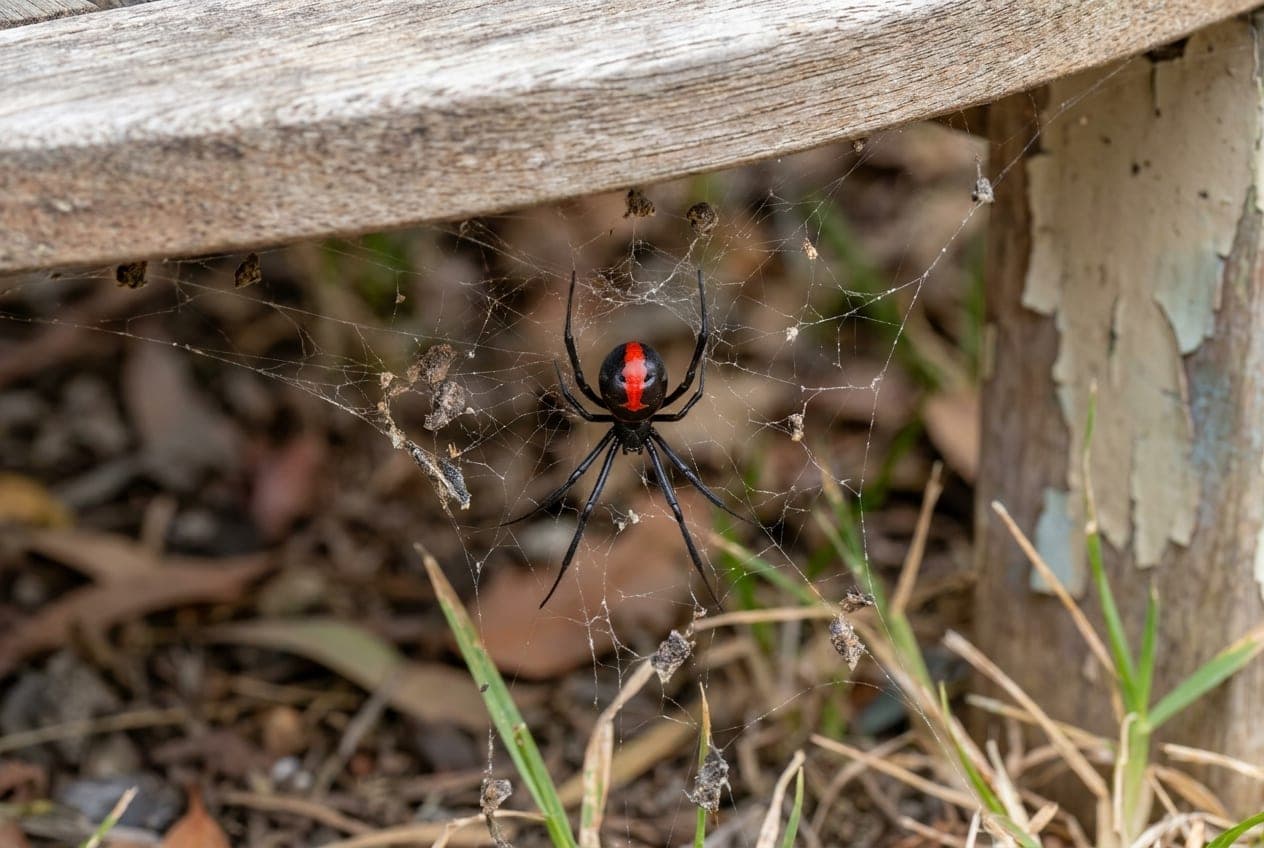
Redback spider treatment for an Adelaide home involves a licensed technician applying a residual insecticide to the spider's preferred harbourage points (under decking, retaining walls, meter boxes, letterboxes) and physically removing existing webs and egg sacs. A single visible web is rarely the whole problem, because redbacks favour the same dry, undisturbed spots year after year.
Adelaide's climate and building style make it particularly hospitable to redbacks. Long dry summers, plenty of besser-block retaining walls, and a lot of timber decking built with gaps and voids underneath add up to ideal habitat. Understanding how treatment actually works, and why a can of spray from the shed rarely fixes a redback problem for good, is the difference between a one-off scare and a yard that stays clear.
Why redbacks thrive in Adelaide yards specifically
Redback spiders (Latrodectus hasselti) do not build random webs. They choose sites that are dry, sheltered from direct weather, close to a ground-level insect food source, and rarely disturbed by human activity. Adelaide's housing stock hands them exactly that in 3 recurring spots.
Under-deck cavities in the eastern and southern suburbs, where timber decking sits over bare dirt or gravel with 30 to 60 centimetres of clearance, are effectively a redback apartment block: dark, dry, undisturbed, and full of the crickets and small insects that wander in from the garden. Besser-block and sleeper retaining walls, common across sloped blocks in the Adelaide Hills foothills and hillside suburbs, have hollow cores and gaps between blocks that offer the same conditions. And letterboxes, particularly the brick-built type set into a front fence, are a near-perfect redback habitat: elevated off the ground, rarely opened more than once a day, and close to a porch light that attracts flying insects at night.
What a licensed technician actually does on site
Redback treatment is not simply spraying every web in sight. The licensed technician we match you with will inspect the property for the harbourage points described above, then apply a residual insecticide directly into cracks, voids and undersides where redbacks shelter, rather than broadcasting spray across open surfaces where it breaks down quickly in UV light and has little effect on a spider that is not actively walking through it. Visible webs and, critically, any egg sacs are removed physically, since egg sacs are largely unaffected by residual chemical treatment and can sit dormant for weeks before hatching.
This last point is where a lot of DIY attempts fall short. Knocking down a web with the end of a broom looks like progress, but if the egg sac attached to it (a papery, cream to fawn-coloured sphere roughly the size of a pea) is not removed and destroyed, it can still release 200 or more spiderlings weeks later, right back into the same undisturbed void the parent chose in the first place.
The mistake we see most: treating the visible web and stopping there
Here is the pattern that brings Adelaide homeowners back for a second call-out almost every time. Someone spots a redback under the barbecue or in the letterbox, sprays or removes that one web, and considers the job done. Weeks later, a child or a family member is bitten reaching into the letterbox or moving a pot plant, because the property still has 4 or 5 other harbourage points that were never inspected, let alone treated.
Redback populations in a yard behave more like a network than a single pest. If the underlying conditions (dry voids, clutter, an insect food source) are still present at every other spot on the block, treating one web only clears the most obvious symptom. A proper treatment plan looks at the whole property: decking, retaining walls, garden edging, woodpiles, garden sheds, letterboxes and meter boxes, not just the one spot where a spider happened to be seen.
Reducing the conditions that invite redbacks back
Treatment knocks the population down, but a few changes around the property make it much less likely to return to previous levels.
- Clear clutter from under decks and around retaining walls (stacked pots, timber offcuts, unused garden edging) since these create exactly the dry, undisturbed voids redbacks prefer.
- Keep woodpiles off the ground and away from the house where possible.
- Check letterboxes and outdoor power points before reaching in, especially after a period of hot, dry weather when redback activity increases.
- Reduce outdoor lighting directly above entry points, since insects drawn to the light are what feed a redback population in the first place.
- Wear gloves when clearing garden debris or moving items that have been undisturbed for a while.
None of this replaces professional treatment where a population is already established, but it does mean a treated property is far less likely to be reoccupied within a season.
Redback bites: a medical matter first
Redback bites are medically significant. The venom can cause a syndrome called latrodectism: localised pain that spreads and intensifies over hours, sweating, nausea and, in more severe cases, more serious systemic effects. Antivenom is available and effective at South Australian hospitals, and the Australian Department of Health's information on venomous spiders is a reliable starting point if you want general background. Any suspected redback bite should go to a doctor or emergency department immediately. Property treatment is the follow-up step, not the first response.
Redbacks alongside other Adelaide pests
Redback activity often shows up alongside other pest pressure rather than in isolation, since the insects redbacks feed on are frequently the same ones drawn in by food scraps, bins, or an existing cockroach or ant problem. If you are dealing with more than one issue at once, our guide on how to get rid of ants in the house and our overview of white-tail spiders in Adelaide, the other spider Adelaide homeowners commonly ask about, cover the related situations we see most.
For a broader look at what else tends to turn up around Adelaide properties through the warmer months, our general pest treatment in Adelaide overview covers how a combined treatment approach, spiders alongside ants and cockroaches, is often more efficient than treating each pest as a separate call-out.
When to book a treatment rather than DIY it
If you are seeing redbacks in more than one location on the property, finding egg sacs, or have young children or pets who use the yard, it is worth booking a proper inspection rather than working through the property web by web. We connect Adelaide homeowners with licensed, vetted technicians who identify every harbourage point on the property, treat accordingly, and remove egg sacs that a spray alone will not touch. Most redback-heavy properties benefit from a follow-up visit a few weeks after the first treatment, simply to confirm nothing has hatched out since.
Redbacks are common across Adelaide and not something to panic about, but they are also not a pest that resolves itself by knocking down the one web you happened to notice. Treating the harbourage points, removing egg sacs, and reducing the clutter that invites them back is what actually keeps a property clear.
Ready to get quotes from licensed technicians?
Tell us about your problem and we match you with a vetted local operator. Free, no obligation.
Get free quotesFrequently asked questions
A licensed technician applies a residual insecticide to harbourage points such as under decking, retaining walls, meter boxes and letterboxes, then physically removes webs and egg sacs. Because redbacks build new webs quickly in the same favoured spots, most Adelaide properties need a follow-up visit within a few weeks to confirm juveniles from any missed egg sacs have not re-established.
Yes. Redback bites are medically significant and can cause serious pain, sweating and nausea that worsens over hours. Antivenom is available at South Australian hospitals and effective, but any suspected bite should be treated as a medical matter first, treatment of the property second.
Redbacks are drawn to dry, sheltered, rarely disturbed voids with a nearby insect food source, which is exactly what besser-block retaining walls, under-deck cavities and letterboxes provide. Removing a web without also treating the harbourage point and clearing clutter usually means a new spider (or a hatched egg sac) reoccupies the same space within weeks.
Redback treatment is usually bundled into a general spider or pest treatment rather than priced as a standalone service, and typically falls within the same range as broader pest treatment in Adelaide. Our [pest treatment quote calculator](/tools/pest-treatment-quote-calculator) gives a fast, tailored estimate based on your property.